
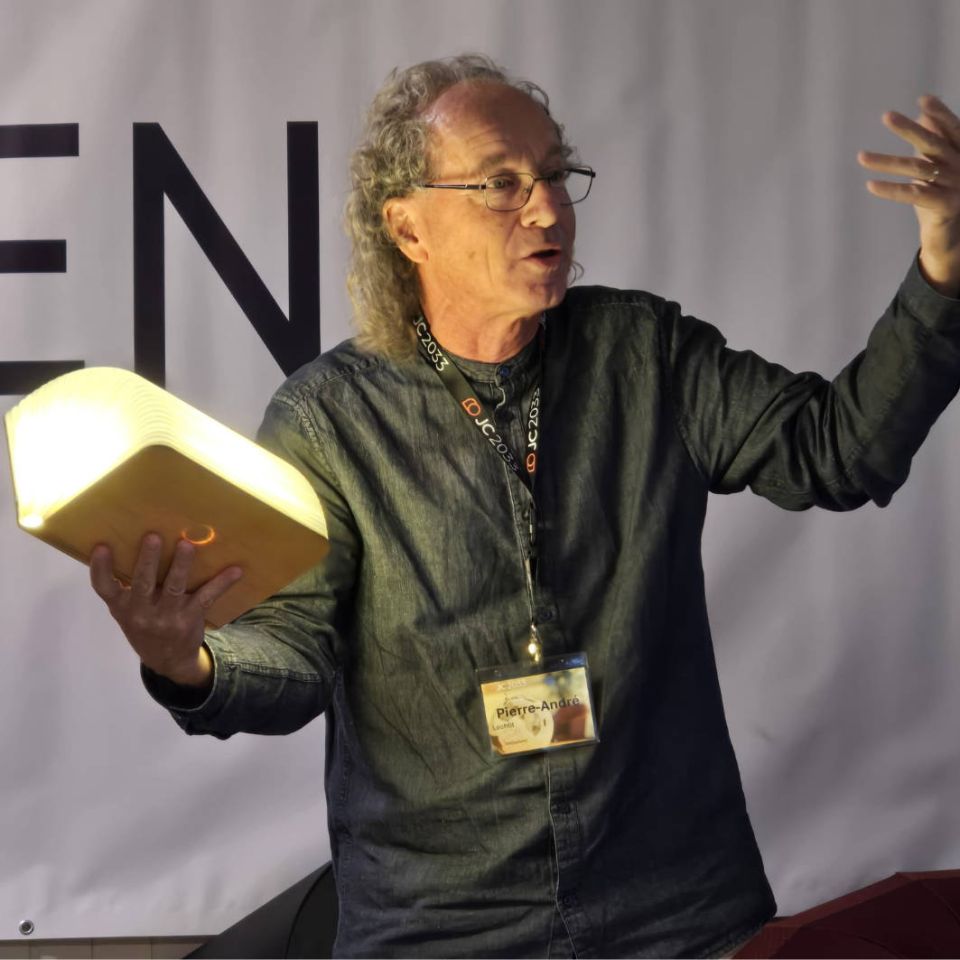
Six years ahead of the Jubilee of the Resurrection, JC2033 continues to grow in many countries. Here are three testimonies gathered during the international ambassadors’ meeting in Burtigny (May 14–16, 2026). They are Mark Williamson from the United Kingdom, Laurent Gerber from Quebec, and Pierre-André Léchot from French-speaking Switzerland. They note that Christian unity, shared witness, and the celebration of the risen Christ are powerful drivers for renewing the Church’s mission in the contemporary world.
United Kingdom: Accelerating the Vision of JC2033
In the United Kingdom, JC2033 has seen remarkable growth over the past year. According to Mark Williamson, a Methodist ambassador, what was until recently just a small group of three ambassadors has become a rapidly expanding network, supported by numerous Christian organizations.
The context in the United Kingdom provides fertile ground thanks to a long tradition of interchurch cooperation. The chosen approach is to work with existing networks rather than create new structures. The Evangelical Alliance, Churches Together, Hope Together, and Share Jesus are already actively participating in this effort. Other collaborations are underway to engage the many local unity groups present in cities and regions.
The movement’s growth has led to the creation of working groups specializing in prayer, media, resources, and public initiatives. Discussions are underway with the BBC and other national media outlets to prepare appropriate coverage of the Jubilee. Plans for street festivals, Christian marches, and public celebrations are also being considered to highlight the unity of Christ’s disciples.
For Mark Williamson, every nation is called to adapt the vision of JC2033 to its own context. In the United Kingdom, where many doubt even the historical existence of Jesus, the message centers on three affirmations: Jesus is real, Jesus is relevant, and Jesus is risen. This contextualized approach allows the message to connect with contemporary realities while remaining faithful to the fundamental mission of JC2033: to proclaim the living Christ together.
Quebec: Unity That Transforms
In Quebec, Laurent Gerber observes that Christian unity is gradually becoming a sign of hope in a highly secularized society. His personal experience of healing, which took place in 1992 during a stay at “La Maison” in Burtigny, has shaped his ministry. Today, as a pastor and chaplain at a women’s prison, he works daily with some of Canada’s most dangerous female inmates. Yet he refuses to define them by their past mistakes. He chooses to see in each of them a future witness to Jesus Christ.
One of the most encouraging changes he has observed is the growing unity among Quebec’s various churches. In the past, denominations often worked separately. Today, they collaborate more closely in training, mission work, and the planting of new congregations. Leaders are learning to share their resources and support one another. Denominational boundaries are gradually losing their significance in the face of the urgency of their shared mission.
L. Gerber also emphasizes the importance of personal relationships. For several years, he has regularly visited church leaders, asking them two simple questions: “Who are you?” and “How can I help you?” This approach to service helps build authentic friendships and overcome prejudices.
Among the promising projects is the creation of a Bible school for Indigenous peoples. This initiative, the result of collaboration among several churches, aims to train leaders from these communities so they can serve their own people. For L. Gerber, the future of Christian witness in Quebec depends on this ability to walk together. Unity is not merely a theological ideal; it becomes a concrete reality that transforms relationships and strengthens the credibility of the Gospel.
French-speaking Switzerland: “Paths of Hope”
In French-speaking Switzerland, the vision of JC2033 is taking shape through a multitude of local initiatives designed to foster unity, witness, and celebration. Pierre-André Léchot, a pastor in Neuchâtel, is convinced that preparations for the Jubilee of the Resurrection must be a long-term endeavor. That is why he encourages the organization of regular activities that allow Christians to journey together toward 2033.
Among the projects carried out is an exhibition dedicated to meals in the Bible, hosted by several churches of different traditions. Beyond its content, this initiative has helped strengthen ties between Christian communities. Similarly, screenings of the series *The Chosen* in Neuchâtel are bringing together a growing number of churches around a shared witness in the public sphere.
The most original initiative is undoubtedly “Paths of Hope.” Inspired by Jesus’ journeys with his disciples, these four- to six-kilometer walking trails invite participants to meditate, pray, and contemplate. Each route consists of fourteen stops combining biblical passages, prayers, and spiritual reflections. Ten such trails already exist in French-speaking Switzerland and can be easily replicated in other regions.
For Pierre-André Léchot, these trails foster not only spiritual growth but also fellowship. They create opportunities for dialogue, hospitality, and brotherhood. They clearly illustrate that the development of JC2033 takes place first and foremost at the local level—in villages, neighborhoods, and cities—where believers learn to get to know one another and bear witness together.
Through these numerous initiatives, French-speaking Switzerland demonstrates that preparation for the Jubilee of the Resurrection does not rely primarily on large-scale events, but on a multitude of encounters, projects, and testimonies that already make the unity of the body of Christ visible.
Help advance the JC2033 vision within your sphere of influence
by Martin Hoegger