
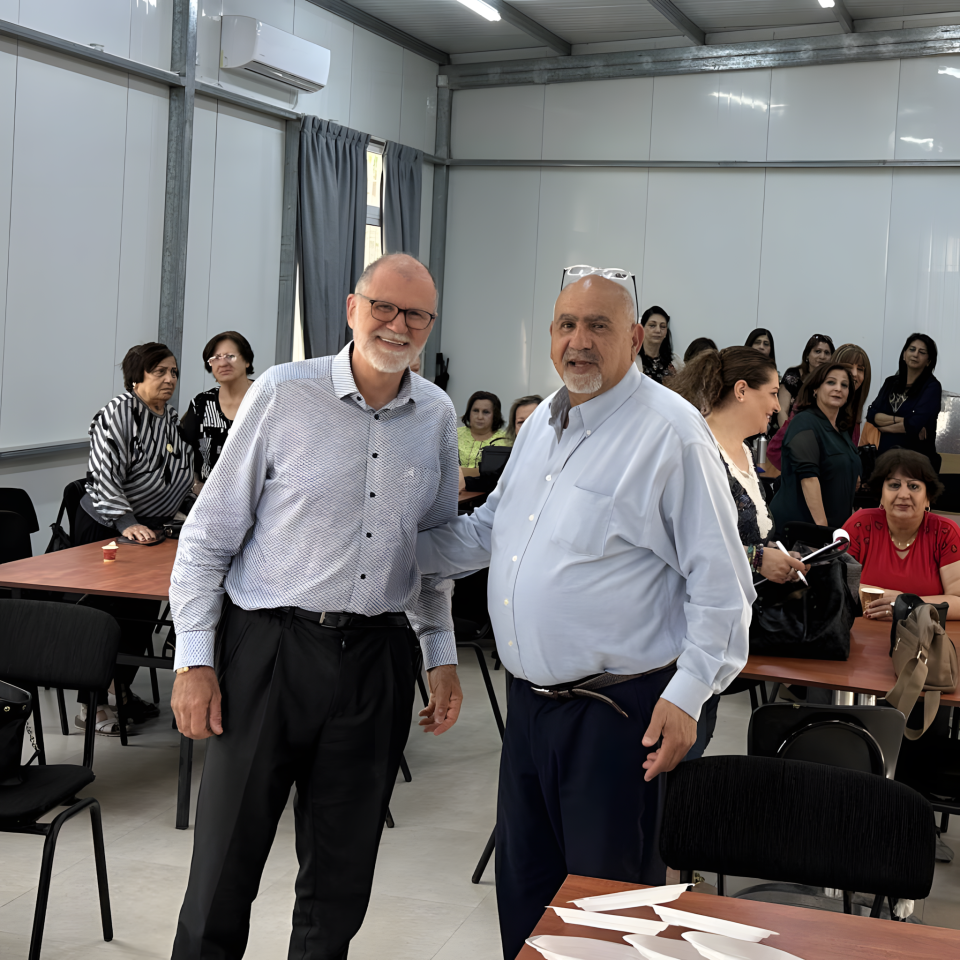
In April, Martin Hoegger met Zoughbi Zoughbi at the Casa Nova restaurant in Bethlehem. The meeting was held in a spirit of unity, in the presence of an Armenian priest, a Greek Orthodox priest, and a senior Muslim sheikh from Bethlehem. Zoughbi was immediately enthusiastic about the JC2033 initiative and wanted to become an ambassador. He insisted that the resurrection is central: without it, there is no Christian faith.
Everyone is surprised to learn that some pastors in Switzerland see it as nothing more than a symbol. For Zoughbi, the resurrection gives courage to Christians in the "Christian triangle," where 300 families have already left the region since October 7, 2023. He is convinced that JC2033 will bring unity and hope to the communities of Bethlehem, and that this celebration will even surpass the scale of the Jubilee in 2000.
The next day, at the Wi'am Center, Martin Hoegger presented JC2033 to about 40 women. The atmosphere was simple and warm, punctuated by personal anecdotes, including one about olive picking at the Emmanuel Monastery in Bethlehem. When Martin asked them what their dream for Bethlehem in 2033 would be, two aspirations come up repeatedly: peace and an end to the occupation.
As he left, Zoughbi confirmed to our colleague his desire to become an ambassador and invited him to meet young people during a future visit.
October Meeting: Young People Torn Between Attachment and Uncertainty
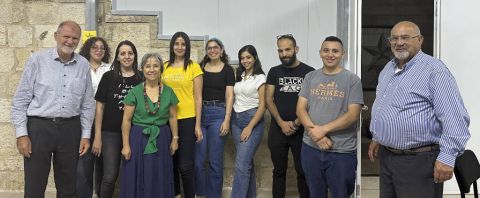 With youth leaders at the Wi'am Center
In October, at Zoughbi's invitation, a dozen youth group leaders from different churches gathered at the Wi'am Center. Martin Hoegger, accompanied by his compatriot Catherine Wüthrich, was struck by the fact that most of the young people in Bethlehem were considering leaving their homeland, despite their deep attachment to the Holy Land. The reason: their future seemed too uncertain.
After the meeting, Zoughbi confided once again that these young people had touched him deeply. They want to live and celebrate life, but they don't know what tomorrow holds for them. His son Rafiq, who was also present, reflected on the question asked at the first meeting: "What is your dream for Bethlehem in 2033?" " For him, the more appropriate question would be: "What is Jesus' dream for 2033?" He sees a vision of peace and light, even in the midst of suffering.
Rafiq explained why he returned to Bethlehem after living a comfortable life in the United States: to support his father in these difficult times and to build a future in his country despite everything. "This is where I feel at home," he says simply.
As for Zoughbi, he is focusing on supporting and encouraging young people. He considers the young people present as his "last children," some already responsible, others still on their way. He believes in their potential to become true agents of change. He, too, dreams that the celebration of the 2,000th anniversary of the resurrection will take place in Bethlehem, in a climate of peace.
To move forward, he insisted on the need to develop a strategy: involve young people more, encourage regional meetings with church leaders, promote exchanges, and reach out to those who cannot travel.
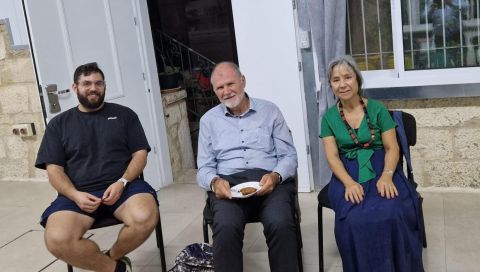 Rafiq Zoughbi, Martin Hoegger, and Catherine Wuthrich
Christian Witness Today
For Zoughbi, the priority for Christians in the Holy Land is to make life possible: to enable work, to guarantee the necessities, to nourish faith, and to seek unity, which he considers essential. The next day, an ecumenical meeting on Christian symbols was to take place, bringing together women, children, and young people.
The evening ended with a Bible meditation. Catherine spoke of Hagar, the woman of the desert, who called God "the God who sees me." Yes, God sees the situation and remains present. The question remains: do we believe that He can act? For Zoughbi, even in the midst of suffering, God offers inner freedom and peace.
As I left Bethlehem, I carried in my heart the testimony of these young people and their elders: their will to live and build despite the precariousness of their situation. The meetings in April and October revealed people who have been tested but who are filled with the light of the resurrection. I discovered that for them, the JC2033 project is a source of courage and hope. In Bethlehem, faith is combined with lucidity, and hope remains, stubborn and alive, in the midst of the present challenges.
Original article written by Martin Hoegger