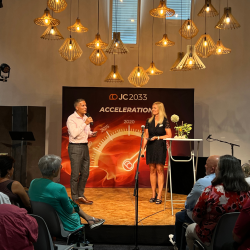
After the Resurrection, everything does indeed seem to accelerate. People run. They return to Jerusalem. They set out to proclaim the Good News to the ends of the earth. Yet this acceleration is never restlessness or haste. It springs from an encounter with the Risen One and leads to faith, unity, and witness.
Peter and the disciple whom Jesus loved: running while waiting
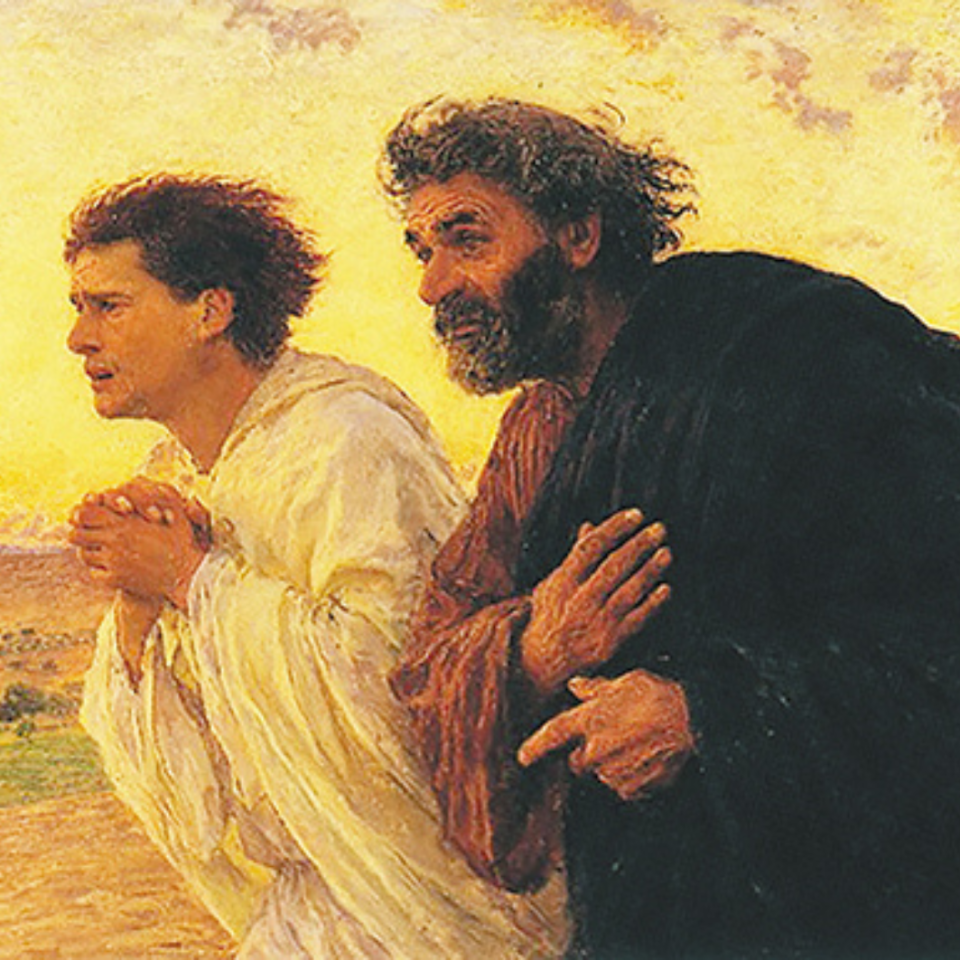
The theme of acceleration immediately reminded me of the story of the race to the empty tomb, beautifully depicted by Eugène Burnand.
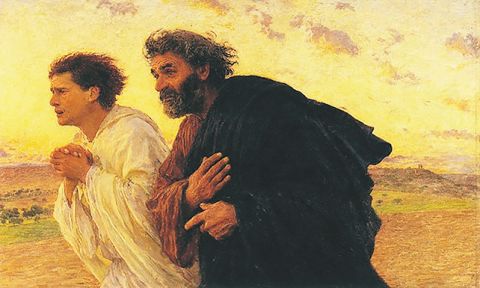 The Disciples Peter and John Running to the Tomb on the Morning of the Resurrection (1898), Musée d’Orsay, Paris.
After discovering that the stone had been rolled away from the tomb, Mary Magdalene ran to tell Peter and the disciple whom Jesus loved. Immediately, the two men set off running as well. The disciple whom Jesus loved arrived first. The Gospel does not name him, as if each of us could recognize ourselves in him. Yet, having arrived before Peter, he does not enter. He leans over, sees the strips of linen, and then waits. Speed does not mean haste or agitation.
Peter arrives next and enters the tomb. He sees the strips of linen and the cloth that had covered Jesus’ head—not left in disarray, but rolled up separately. This detail is striking. It seems as though God is “tidying up” and restoring order. Then the disciple whom Jesus loved enters as well. “He saw and believed” (John 20:8). He is the first to believe without having yet encountered the Risen One. Haste can blind us. But he waited, and he sees with his heart and believes. This disciple is thus a model of Jesus’ disciple. He stood at the foot of the cross, and now he believes before the empty tomb. Following Jesus means remaining faithful in the face of trials and trusting in the power of his resurrection.
As 2033 approaches, initiatives will certainly multiply. A question will then arise, “Will we enter into a race where everyone wants to be first, impose their own agenda, or pull the blanket over themselves?”
The disciple whom Jesus loved arrived first, but he waited for Peter. Here is an image for our journey toward 2033. We must wait for one another. Some run faster, others move more slowly. Some have greater resources, networks, or visibility, but we can only truly move forward together by respecting the pace of others—especially that of the least among us.
The Disciples on the Road to Emmaus: From Burning Hearts to Hasty Steps
The story of Emmaus shows us another kind of acceleration. Two disciples leave Jerusalem, overwhelmed by Jesus’ death. They walk slowly, trapped in their disappointment, “We had hoped…” (Luke 24:21). A stranger joins them and walks with them. He listens to their distress, then explains the Scriptures to them. Little by little, something changes within them. After recognizing Jesus when he broke the bread, they said to one another, “Did not our hearts burn within us while he spoke to us on the road?” Acceleration thus begins within. Before their steps quicken, their hearts are set ablaze. Then “their eyes were opened.”
This expression recalls the story of Adam and Eve. But here, the movement is reversed. After their eyes were opened, Adam and Eve hid from one another and from God.
Luke may be suggesting here that the unnamed disciple is Cleopas’s wife. At Emmaus, unlike in the Garden of Eden, the eyes opened by the Risen One lead to communion and witness.
 Stig Petrone: The two disciples of Emmaus on their way back to Jerusalem… accompanied by the spiritual presence of the Risen One. (Private collection).
And these two disciples already form a small community. Paul will say, “In the Lord, the woman is not without the man, nor the man without the woman” (1 Corinthians 11:11). Together, they recognize the Risen One. Together, they set out again and carry out their ministry. They rise “at once” and return to Jerusalem. The night no longer holds them back. The encounter with the Risen Christ sets off a twofold acceleration: an inner one, because their hearts are burning, and an outer one, because their feet are setting out once more.
This is what we can ask for on the journey toward 2033. Not first and foremost more activities, but hearts on fire that set our steps in motion.
Thomas: From Doubt to Mission
Thomas reveals to us a third dimension of this acceleration. Doubt regarding the Resurrection is a reality of all times. It is particularly prevalent in our post-Christian societies and has also shaped certain currents in modern theology. Thomas teaches us something essential. It is not enough to simply repeat the “kerygma” (the heart of the Gospel, the death and Resurrection of Jesus), however indispensable it may be.
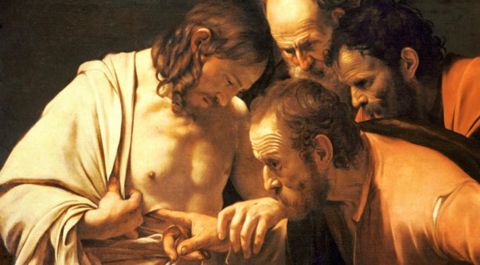 Caravaggio, “The Incredulity of Thomas” (1603), Sanssouci Palace, Potsdam.
The other disciples tell him, “We have seen the Lord!” But their testimony is not enough for him.
Jesus himself must come to meet him.
It is ultimately the Risen One who transforms Thomas. Jesus comes among the disciples and personally invites him to move from doubt to faith. Thomas then responds with one of the most powerful confessions of faith in the entire New Testament, “My Lord and my God!”
After this encounter, according to an ancient Christian tradition, Thomas’ life took on an extraordinary missionary momentum. His witness is associated with the East. Ancient traditions link his journey to India, while others link it to China.
For me, this tradition has taken on a very concrete dimension. Last year, Olivier Fleury and I visited Taxila, in northern Pakistan, where the apostle Thomas is said to have stopped and testified about Christ to King Gondophares. I was particularly moved to spend two days in this city, which had heard the Gospel long before Switzerland did! This broadened our perspective. From the very first centuries, the Gospel set out for the East just as it did for the West. On the path toward 2033, we are called to rediscover this universal scope of the resurrection.
When we began the JC2033 global prayer about ten years ago, we were just a few people gathered in our offices. Today, on the last Friday of every month, people from some twenty countries pray together. What a surge!
This encourages us to look toward 2033 with faith. May we hope that, on Easter morning 2033, great nations like India and China—which together account for a considerable portion of humanity—will hear this proclamation in their native languages—more than a thousand in total, “Christ is risen! He is truly risen!”
This missionary acceleration, however, does not come from our strategies alone. As with Thomas, it begins with an encounter. The Risen One comes among us.
The True Catalyst: The Risen Jesus in Our Midst

This brings us to the heart of the acceleration toward 2033.
The true catalyst is neither an organization, nor a communication strategy, nor an increase in events. It is the Risen Jesus present in our midst. “Where two or three are gathered in my name, there am I among them” (Matthew 18:20).
But this promise calls us to a particular way of living together. First, we must be in agreement. Just before this statement, Jesus declares, “If two of you on earth agree to ask for anything… ” (Matthew 18:19). The Greek word evokes a symphony.
The acceleration toward 2033 will therefore be an acceleration of communion, learning to listen to one another, to discern together, to harmonize our differences, and to rejoice in the gifts that God has entrusted to others.
Next, we are to gather “in His name.” This means more than simply saying Jesus’ name at the beginning of a gathering. To gather in His name is to seek to live among ourselves as He Himself lives with us. It is to place His commandment of mutual love at the center of our relationships.
Paul expresses this beautifully, “Therefore, welcome one another, just as Christ has welcomed you, for the glory of God (Romans 15:7).” Perhaps this is the essential discernment for the years leading up to 2033. Not merely asking ourselves how to do more, but how to allow the Risen One to be more fully present among us.
We will discover that the path toward 2033 is not primarily our own project. It is the Risen One who comes to us, gathers us together, and sends us forth. The more we make room for Him in our midst, the more He Himself will be able to accelerate this movement of unity and witness, so that the joy that began it all on Easter morning may resound to the ends of the earth.
“Christ is risen! He is truly risen!”
Celebrating Easter on the Road to Emmaus