The Beauty and Challenge of Unity: Complementarity in the Service of the Kingdom
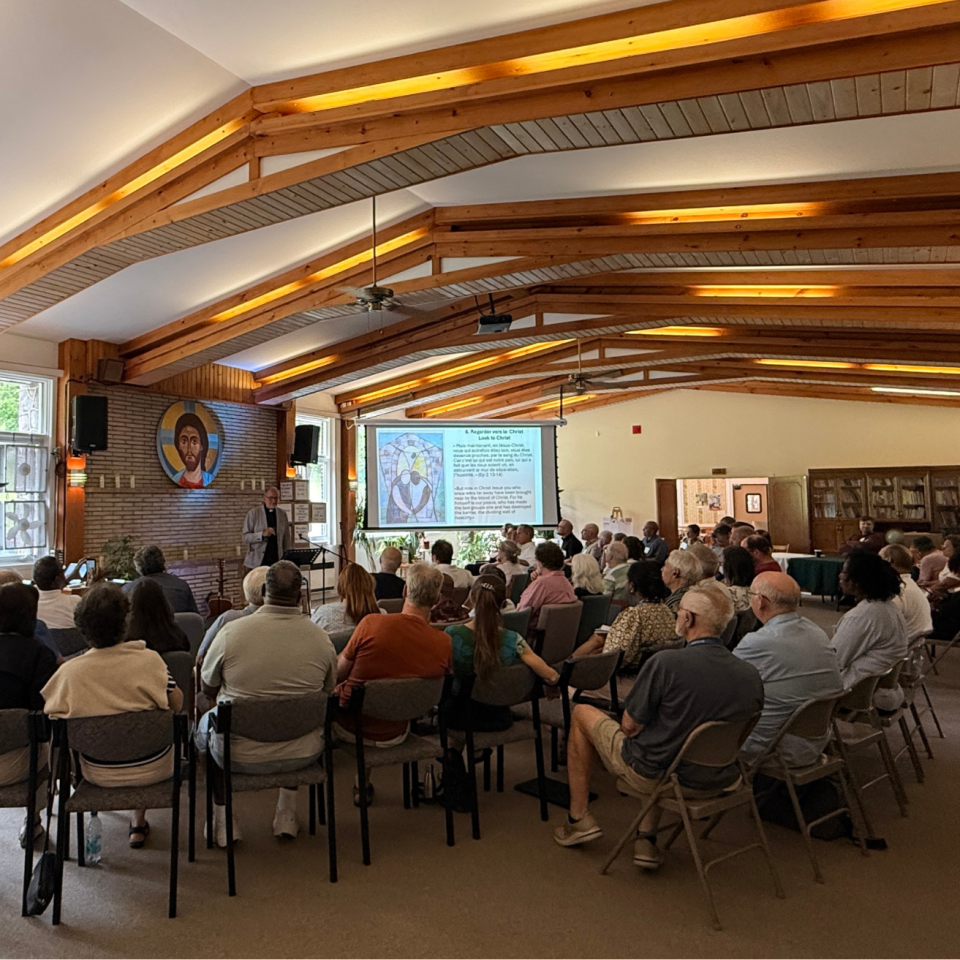
On behalf of the Chemin Neuf Community, its director, Yves Patrick Augustin, welcomed the participants by reminding them that unity lies at the heart of the Christian vocation. Using the image of a family whose children love their parents but remain divided among themselves, he showed how much these divisions wound God’s heart. Unity, therefore, is not merely an institutional matter; it directly affects the witness of the Gospel. “In a world marked by divisions, Christ’s disciples are called to become artisans of reconciliation. This vocation requires humility and openness to the work of the Holy Spirit,” he said.
Pentecostal Pastor Laurent Gerber, coordinator of JC2033-Québec, illustrated unity using the image of a sports team in which each member contributes a particular talent toward a common goal. According to him, JC2033 is based on the conviction that every church has a unique contribution to make to God’s plan. Differences in culture, tradition, or spirituality are not obstacles but riches to be embraced. “Such an attitude allows us to build unity grounded in love, mutual respect and the recognition of God’s work in each person’s life.”
Unity: A Challenging Journey
Olivier Fleury, director of JC2033 International, acknowledged that the pursuit of unity can involve misunderstandings and resistance. He compared it to a demanding journey where criticism can arise from various directions. He recounted an experience in London that led him to discover the spiritual richness of the Catholic Church. This encounter transformed his perspective and strengthened his ecumenical commitment. His conviction is that “differences must never make us forget what is essential: Christ who died and rose again. All believers live by the same grace and are called to manifest this grace in their mutual and fraternal relationships.”
Bishop Louis Corriveau of the Diocese of Joliette offered a reflection on the story of Emmaus as a model of Christian unity. He emphasized that the disciples are on a journey, symbolizing a unity that is always in the making. Their journey together reminds us that the Gospel is transmitted through relationships and shared witness. Jesus begins by listening to their sorrow before explaining the Scriptures to them, thus demonstrating the importance of respectful dialogue.
Sharing the Word deepens mutual understanding: “When believers from different Churches open the Scriptures together, they often discover a new joy and a richer understanding of the Gospel message.” Finally, the breaking of bread and the return to Jerusalem demonstrate that the encounter with the Risen One always leads to a broader communion.
The Two Pillars of Unity: Love and Truth
In his address, Pastor Martin Hoegger of the Evangelical Reformed Church of Switzerland showed that Christian unity rests on two inseparable dimensions: love and truth. Drawing on the text of John 17, he recalled that Jesus prays that all may be one, in the image of the communion between the Father and the Son. This unity is not uniformity, but a relationship founded on mutual love. It is also rooted in the truth of God’s Word, which sanctifies believers and prepares them for their mission.
When the two dimensions of love and truth remain united, the Church can offer the world a credible witness to the Gospel. “On the journey toward 2033,” he concluded, “we are invited to deepen this twofold fidelity. As we look together toward the crucified and risen Christ, we discover that even today he continues to tear down the walls that separate us.”
Unity in the Risen Christ: Justice, Unity, and Peace—Three Inseparable Realities
Orthodox Metropolitan Cyril developed a reflection centered on the Risen Christ. He recalled that the heart of the Christian faith is the proclamation that Jesus, who died on the cross, lives forever. In the Gospel account, the disciples recognize the Lord at the breaking of bread. This experience shows that unity finds its source in the encounter with the Risen One.
The Metropolitan distinguished between fraternal union—already evident in collaboration among Christians—and full unity. “Unity, as understood in the Orthodox tradition, refers to a more complete communion, rooted in a shared faith and expressed in the sharing of the same chalice. The Eucharist thus appears as both the sign and the fulfillment of Christian unity.”
Peter Noteboom, General Secretary of the Council of Churches of Canada, addressed the relationship between Christian unity and social justice. In his view, unity cannot be authentic if it remains indifferent to human suffering. Grounded in the dignity of every person created in the image of God, justice aims to restore just relationships among individuals, communities, and creation.
He emphasized the importance of solidarity with the most vulnerable. “Unity becomes visible when believers work together to support the poor, welcome migrants, promote reconciliation, and build a more just society,” he said. True peace arises from these commitments.
Unity in a Few Words
In the closing roundtable discussion, each speaker was invited to express the concept of unity in a few words: unity in diversity, a shared journey guided by Scripture, shared responsibility, or communion in the truth of Christ. All emphasized that the resurrection remains the source of Christian hope, and the foundation of their shared witness. The participants recalled that unity is not a distant goal but a calling to be lived out today. The meeting concluded in prayer, with an invitation to keep Christ at the center of every endeavor. It is in Him that divisions can be overcome and that the journey toward 2033 takes on its full meaning.
Martin Hoegger