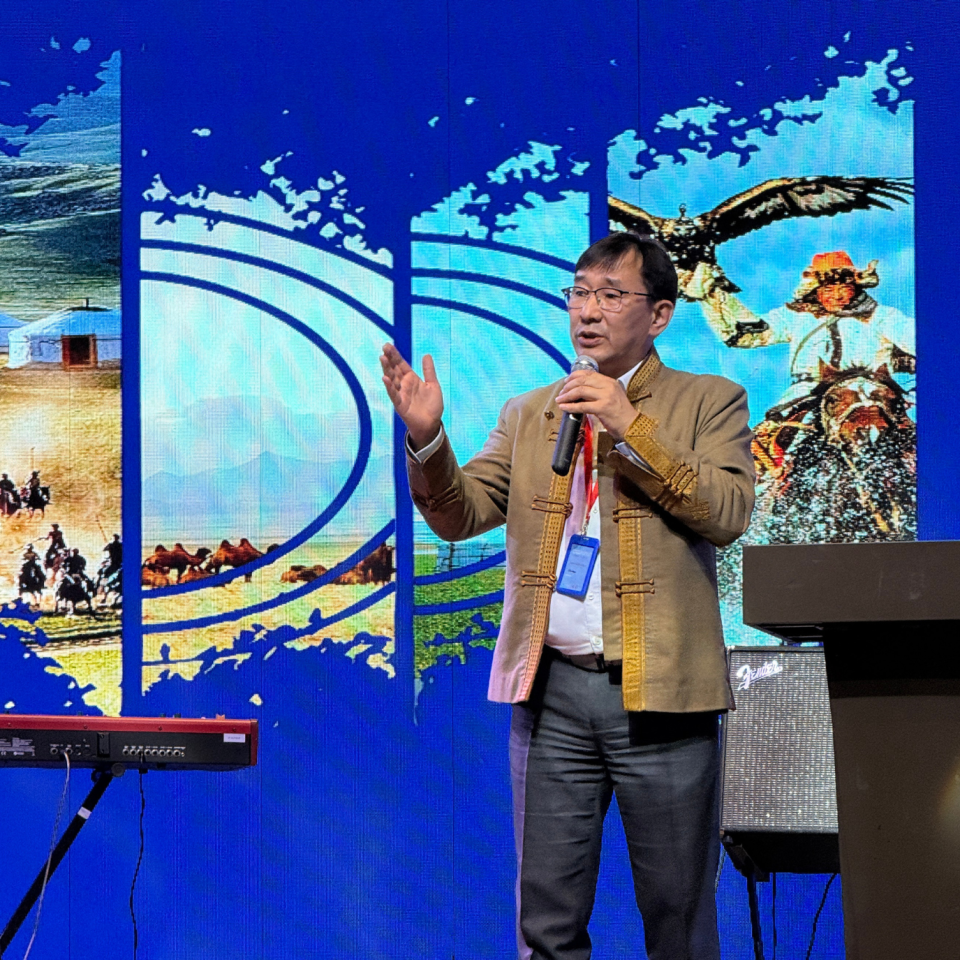
Under the vast and magnificent dome of a guest yurt at the “Glory Resort” complex, nestled in Terelj National Park not far from Ulaanbaatar, enthusiastic representatives from various denominations—hailing from Mongolia, Switzerland, the United States, Europe, and Russia—shared their common vision.
“May they all be one, just as you, Father, are in me and I am in you… so that the world may believe that you have sent me.” (John 17:21)
The call is simple, yet immense: to mobilize Christians, churches, and ministries around the world to celebrate the 2,000th anniversary of the resurrection of Jesus Christ in 2033.
The very location of the gathering seemed to echo Jesus’ words after His resurrection, “You will receive power when the Holy Spirit comes upon you, and you will be my witnesses…to the ends of the earth.” (Acts 1:8)
Mongolia: Between Vastness and Spiritual Quest
A vast territory, it is among the least densely populated in the world. Mongolia has a rich history, marked by the figure of Genghis Khan, founder of the Mongol Empire in the 13th century. A gigantic equestrian statue, the largest in the world, pays tribute to him at Tsonjin Boldog.
But “there is a time for everything” (Ecclesiastes 3 :1).
Today, the country has a population of approximately 3.4 million, representing 72 nationalities. Part of the population still lives a nomadic lifestyle in the mountains, while the rest is concentrated in the capital. It is not uncommon to come across, amid modern high-rises, a rider in traditional attire coming to run errands on horseback.
The dominant religion remains Tibetan Buddhism. Islam accounts for about 3% of the population, and shamanic traditions persist. In the steppes, ovoos—piles of stones and wood adorned with ribbons—still bear witness to these ancient spiritual practices.
And yet, in the midst of all this, another reality is taking shape.
There are now more than 50,000 Christians in Mongolia. The Gospel is spreading rapidly. About 500 evangelical churches are active, along with numerous house groups. In some nomadic camps, a simple yurt becomes a place of worship. Sometimes, a woman leads a group of 12 to 15 other women—often Muslims—at the cost of family persecution. There is a discreet and very courageous faith.
Some Mongolian pastors, trained in Europe or the United States, have chosen to return to serve in their homeland. This is the case for Michel Bayarsaikhan, 26, who became a believer at age 16. After studying in the United States, he gave up a promising career to answer God’s call. Today, he serves as a leader with Youth With A Mission alongside his wife, Bairma. During the conference, he tirelessly provided translation between Mongolian and English while also making coffee for participants at the reception.
In the middle of April, the windiest month of the year, the large yurt at the “Glory Resort” complex became a true place of divine visitation. From morning to night, worship, preaching, prayer, and testimonies followed one another. The very architecture of the yurt seemed to amplify the voices: the sound rose, concentrated, toward the central opening, like an offering carried toward the sky. A conviction took hold: the Lord is alive.
“Kingdoms of the earth, sing to God, celebrate the Lord!” (Psalm 67:33)
At the origin of this movement is Olivier Fleury, who received a vision in 2007: to celebrate the 2,000th anniversary of Christ’s resurrection on a global scale.
Since then, he has called on Christians to gather around three pillars:
- Unity: bringing believers together beyond their differences, around Jesus Christ crucified and risen
- Witness: proclaiming the Gospel together to the ends of the earth
- Celebration: to experience this anniversary in a joyful, creative, and visible way in society
“This is not a Swiss project,” Olivier says. “It is God’s plan.”
Today, the movement continues to grow: prayer networks, online meetings, the translation of the vision book in multiple languages, the organization of conferences at various levels, an increase in the number of ambassadors… everyone is invited to take part.
A notable development: the various Christian denominations have already set a common date to celebrate Easter in 2033—April 17. This rare unity is the result of extensive dialogue, including with top-level leaders from the various denominations.
When asked about the purpose of this gathering in Mongolia, Olivier Fleury simply replied, “To kindle a fire in the hearts of the servants. To encourage them to continue to proclaim Jesus.”
He added: “More than two million Mongolians have not yet heard of Jesus Christ. But those who were here can take up this challenge. With a smile… and with the love that only Christ can give.”
And what if…
“...the Lord returned before 2033?”
The answer, full of simplicity, brings a smile:
“Then I’ll have less work! But if not, God will record this day and this place in the Book of Life.”
April 26, 2026
by Alla Stambolidi, freely translated by the JC2033 team
JC2033 Ambassador in Moscow
Ph.D. in History, Member of the Union of Journalists of Russia